
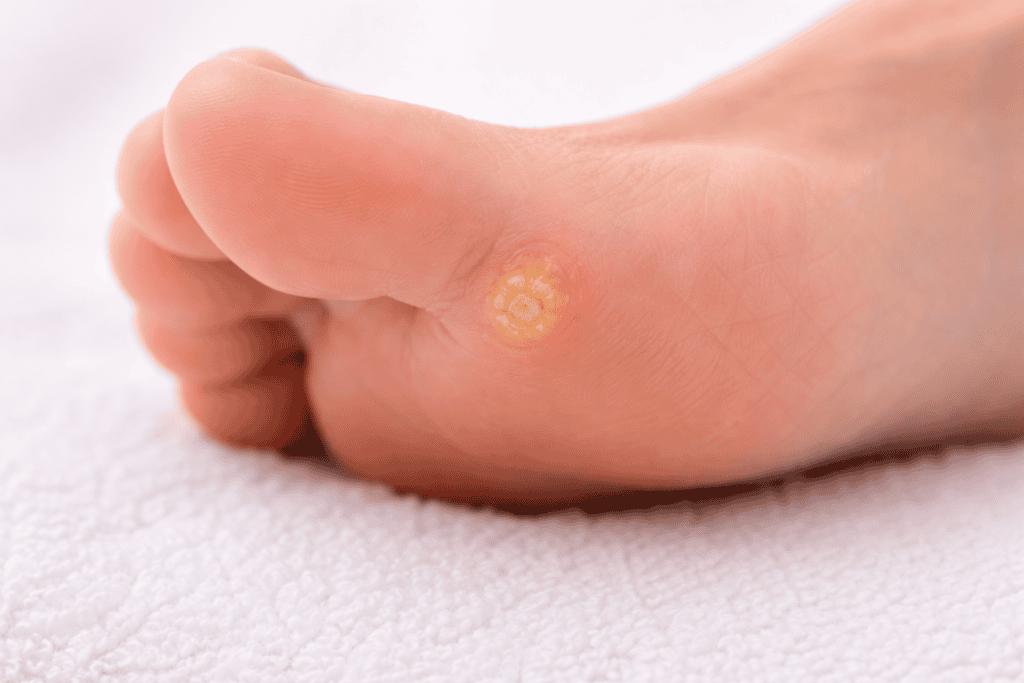
Corns and calluses are among the most common foot complaints in the UK — and also among the most misunderstood. Many people put up with the discomfort for months or even years, not realising that a podiatrist can usually deal with them in a single appointment, quickly and painlessly.
This guide explains what corns and calluses are, what causes them, how to treat them safely at home, and when it’s time to get professional help.
What are corns and calluses?
Both corns and calluses are areas of thickened, hardened skin that develop in response to repeated friction or pressure. They are the skin’s protective response — building up a tougher layer to defend itself against ongoing irritation.
Despite having the same underlying cause, they are distinct conditions:
Calluses
A callus is a broad, flat area of thickened skin, usually with a diffuse edge rather than a defined centre. Calluses are generally less painful than corns — or not painful at all — and tend to develop on the ball of the foot, the heel, or the outer edge of the big toe. They are the skin’s response to widespread, repeated pressure.
Corns
A corn is a smaller, more concentrated area of hardened skin with a defined, often translucent centre called the nucleus or core. It is this hard central plug that causes the characteristic sharp, stabbing pain — the nucleus presses inward like a stone in the foot when you walk.
There are two main types of corn:
- Hard corns (heloma durum) — the most common type. A small, defined area of very hard, dense skin, typically on the tops or tips of toes, or on the ball of the foot. Usually caused by pressure from footwear.
- Soft corns (heloma molle) — found between the toes, where moisture from sweat keeps them soft and rubbery. Soft corns are often whitish in colour and can be very painful. They develop when two bony surfaces in adjacent toes press against each other.
What causes corns and calluses?
The root cause is always the same: repeated friction or pressure on a specific area of skin. Common contributing factors include:
Ill-fitting footwear is by far the most common cause. Shoes that are too tight compress the toes and create pressure points. Shoes that are too loose cause the foot to slide, creating friction. High heels shift body weight onto the ball of the foot, causing calluses there.
Foot shape and structure plays a significant role. Bony prominences — such as hammer toes, bunions, or a high arch — create pressure points where the skin repeatedly rubs against footwear. People with these structural issues are more prone to recurring corns.
Going without socks increases friction between the foot and the shoe.
Occupation and activity matters too. People who stand for long periods, walk long distances, or take part in sports that put repeated stress on the feet are more susceptible.
Age is also a factor. As we get older, the fatty pads under the ball of the foot and heel thin out, reducing natural cushioning and making those areas more vulnerable to pressure-related skin changes.
How to treat corns and calluses at home
For mild corns and calluses that aren’t causing significant pain, there are several safe home care approaches.
Soaking and filing
Soaking the foot in warm water for 10 to 15 minutes softens the thickened skin, making it easier to gently file away with a pumice stone or foot file. Work gently — don’t try to remove the corn or callus in one session. A little progress each day is safer than aggressive filing, which can cause soreness or even break the skin.
Always dry your feet thoroughly after soaking, particularly between the toes.
Moisturising
Applying a good urea-based foot cream daily helps keep the skin soft and supple, reducing the build-up of hard skin over time. Look for creams containing 10% to 25% urea — these are available from pharmacies without a prescription and are significantly more effective than ordinary body lotion for hardened foot skin.
Corn plasters and pads
Medicated corn plasters containing salicylic acid can help soften and reduce a corn, but use them with care. They work by dissolving skin — applied carelessly, they can damage the healthy skin surrounding the corn. They should not be used by people with diabetes, poor circulation or fragile skin.
Non-medicated foam or gel pads are a safer option for pain relief — they cushion the corn and reduce pressure without the risk of chemical damage to surrounding skin.
Footwear changes
Addressing the underlying cause is essential. No treatment will produce lasting results if you continue wearing the shoes that caused the problem. Consider:
- Switching to shoes with a wider toe box to reduce pressure on the toes
- Avoiding high heels for prolonged periods
- Always wearing socks
- Using cushioned insoles to reduce pressure on the ball of the foot and heel
What to avoid
Two things you should never do when treating corns at home:
Never cut a corn with a blade or scissors. This is dangerous. Home “corn cutting” risks cutting too deep, breaking the skin and introducing infection. It also doesn’t remove the nucleus — the hard central core — so the corn returns quickly.
Don’t use medicated corn plasters if you have diabetes or poor circulation. The salicylic acid in these products can break down healthy skin as well as hardened skin, and in people with reduced sensation or compromised healing, this can lead to ulcers and serious complications. Always seek professional advice instead.
Professional treatment — what a podiatrist can do
A podiatrist can remove a corn or reduce a callus quickly, safely and with minimal discomfort — usually in a single appointment. This is called debridement.
Using a sterile scalpel, the podiatrist carefully pares away the thickened skin and removes the nucleus of the corn. The procedure is painless for most people because the thickened skin has no nerve supply — you feel pressure but not pain. Many patients are surprised by how straightforward and effective it is.
The relief is often immediate. Walking out of the appointment is noticeably more comfortable than walking in.
Will the corn come back?
This depends entirely on whether the underlying cause is addressed. If the same footwear is worn and the same pressure continues to be applied to the same area, the corn will return — typically within a few weeks to months. Regular podiatry appointments every 6 to 12 weeks can keep the corn managed, but the long-term solution is to address the root cause.
Where the cause is structural — such as a bunion or hammer toe — a podiatrist may recommend:
- Custom orthotics — insoles made to redistribute pressure away from the problem area
- Padding and silicone devices — to protect bony prominences from rubbing against footwear
- Footwear advice — specific recommendations for shoe styles and fittings
- Referral for surgical assessment — in cases where the underlying structural problem (such as a severe hammer toe or bunion) is the primary driver
When should you see a podiatrist?
You should seek professional advice if:
- You have diabetes, poor circulation, neuropathy or any condition affecting your feet — always seek professional care rather than treating at home
- The corn or callus is causing significant pain
- The skin around the corn appears red, swollen or feels warm — this may indicate infection
- Home treatment hasn’t improved the situation after 4 to 6 weeks
- The corn keeps coming back despite addressing your footwear
- You have a soft corn between your toes that is particularly painful or showing signs of breakdown
- You are elderly or have difficulty reaching your feet safely
Preventing corns and calluses
The most effective prevention is choosing footwear that fits properly and doesn’t create pressure points:
- Have your feet measured properly — foot size often changes with age
- Choose shoes with a wide, deep toe box that doesn’t compress the toes
- Avoid wearing high heels for prolonged periods
- Always wear well-fitting socks
- Use cushioned insoles if you stand or walk for long periods
- Moisturise your feet regularly to keep skin supple
- See a podiatrist regularly if you are prone to corn and callus formation — regular maintenance is far easier than dealing with a painful build-up
Find a podiatrist near you
A podiatrist can remove a painful corn or reduce a callus quickly and safely — usually in a single appointment. Search our directory to find HCPC-registered foot health specialists in your area.
This article is for general information only and does not constitute medical advice. Always consult a suitably qualified practitioner — see an HCPC-registered podiatrist or chiropodist for diagnosis and treatment of any foot condition.

Author: FootcareUK
Written by
FootcareUK Editorial Team
These guides give general information about foot health for a UK audience. They are not a substitute for a personal assessment — a podiatrist, chiropodist or foot health practitioner can examine your feet and advise on your own situation. If you spot something that looks wrong, tell us and we will correct it.