
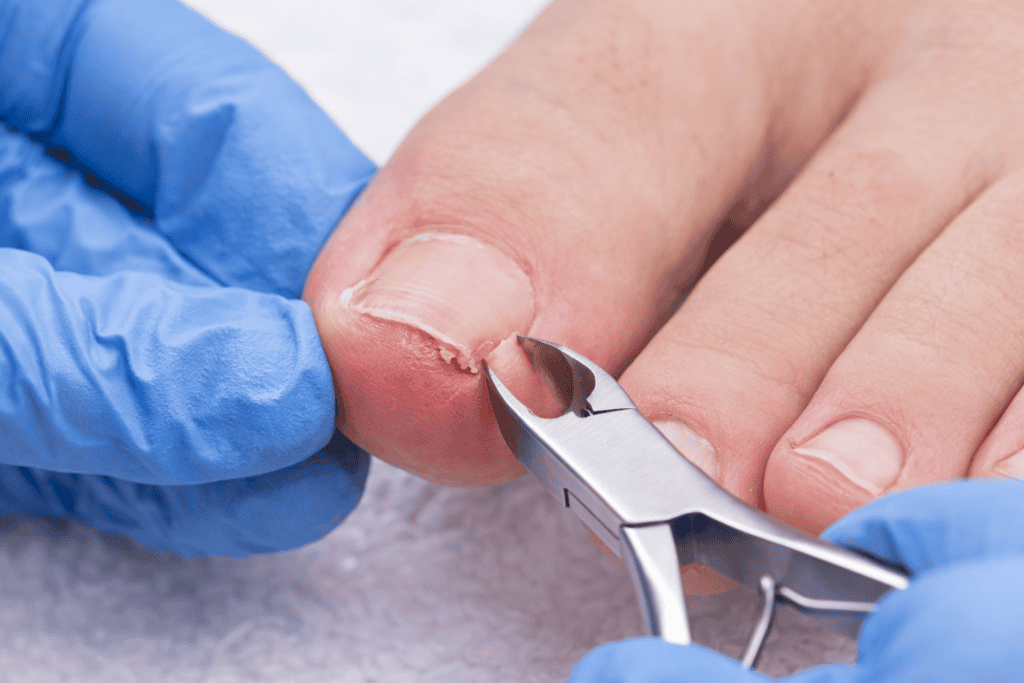
Ingrown toenails are one of the most common reasons people visit a podiatrist in the UK — and one of the most uncomfortable things you can deal with on a day-to-day basis. The good news is that most cases can be resolved, either at home with careful treatment or with a straightforward procedure from a foot health specialist.
This guide explains what causes ingrown toenails, what you can do at home, and when it’s time to get professional help.
What is an ingrown toenail?
An ingrown toenail — known medically as onychocryptosis — happens when the edge or corner of a toenail grows into the surrounding skin rather than over it. The big toe is most commonly affected, though it can happen on any toe.
The result is pain, redness and swelling around the nail edge. In more serious cases the skin can become infected, producing discharge and significant discomfort when walking or wearing shoes.
What causes ingrown toenails?
Several factors can contribute to ingrown toenails:
Cutting nails incorrectly is the most common cause. Cutting nails too short, or rounding the corners rather than cutting straight across, encourages the nail to grow into the skin at the sides.
Tight or ill-fitting footwear puts pressure on the toes and can push the skin against the nail edge, particularly in the big toe.
Nail shape plays a role too — some people naturally have more curved nails that are more prone to becoming ingrown.
Injury to the toe, such as stubbing it or dropping something on it, can cause the nail to grow abnormally.
Sweaty feet can soften the surrounding skin, making it easier for the nail to penetrate.
How to treat an ingrown toenail at home
For mild cases with no signs of infection — a little redness and tenderness, but no discharge or significant swelling — you may be able to manage the problem at home.
Soak the foot regularly. Soaking your foot in warm, slightly salty water for 15 to 20 minutes, two to three times a day, helps soften the skin and reduce inflammation. Dry the foot thoroughly afterwards.
Gently lift the nail edge. After soaking, when the skin is soft, you can carefully try to lift the edge of the nail away from the skin using a clean cotton wool ball or a piece of clean dental floss tucked under the nail corner. This encourages the nail to grow over the skin rather than into it. Don’t force it — if it’s painful, stop.
Wear open-toed shoes or sandals while the nail heals to reduce pressure on the toe.
Keep the area clean and apply an antiseptic to reduce the risk of infection.
Avoid cutting the nail aggressively or digging at the nail edges — this often makes things worse and can introduce infection.
Signs you need to see a podiatrist
Home treatment works well for mild ingrown toenails, but there are clear signs that you need professional help:
- The toe is visibly infected — there is pus or discharge, significant swelling, warmth or redness spreading beyond the nail
- The pain is severe or getting worse
- You have diabetes, poor circulation or any condition affecting your feet — in these cases even a minor ingrown nail can become serious and you should seek help promptly
- The nail has been ingrown repeatedly and keeps coming back
- Home treatment hasn’t improved the situation after a week or two
A podiatrist can assess the nail, remove the problematic nail edge under local anaesthetic if needed, and treat any infection. There’s no need to suffer with an ingrown toenail — it’s a very common and very treatable problem.
What does treatment involve?
For mild to moderate cases a podiatrist will often be able to remove the offending piece of nail in a single appointment. The procedure is done under local anaesthetic so the toe is numb, and most people find it far less unpleasant than they expected.
For recurring ingrown toenails, or where the nail keeps growing back into the skin, a more permanent solution called a partial nail avulsion (PNA) is often recommended. This involves removing the side section of the nail permanently using a chemical called phenol to prevent regrowth. It’s a minor procedure with a high success rate and most people can walk out of the clinic afterwards.
Recovery typically involves keeping the toe clean and dressed for one to two weeks. Full healing usually takes four to six weeks.
How to prevent ingrown toenails
Once you’ve dealt with an ingrown toenail, a few simple habits will help prevent them coming back:
- Cut nails straight across — not curved or too short. Leave a small amount of white nail visible at the tip.
- File rather than cut if your nails are prone to splitting or sharp edges.
- Wear well-fitting shoes with enough room in the toe box. Avoid tight, pointed footwear for long periods.
- Keep feet clean and dry, particularly between the toes.
- See a podiatrist regularly if you have difficulty cutting your own nails safely, or if ingrown toenails are a recurring problem.
Find a podiatrist near you
If you’re dealing with an ingrown toenail and home treatment isn’t working, a qualified podiatrist can help. Search our directory to find HCPC-registered practitioners in your area.
This article is for general information only and does not constitute medical advice. Always consult a suitably qualified practitioner — see an HCPC-registered podiatrist or chiropodist for diagnosis and treatment.

Author: FootcareUK
Written by
FootcareUK Editorial Team
These guides give general information about foot health for a UK audience. They are not a substitute for a personal assessment — a podiatrist, chiropodist or foot health practitioner can examine your feet and advise on your own situation. If you spot something that looks wrong, tell us and we will correct it.