
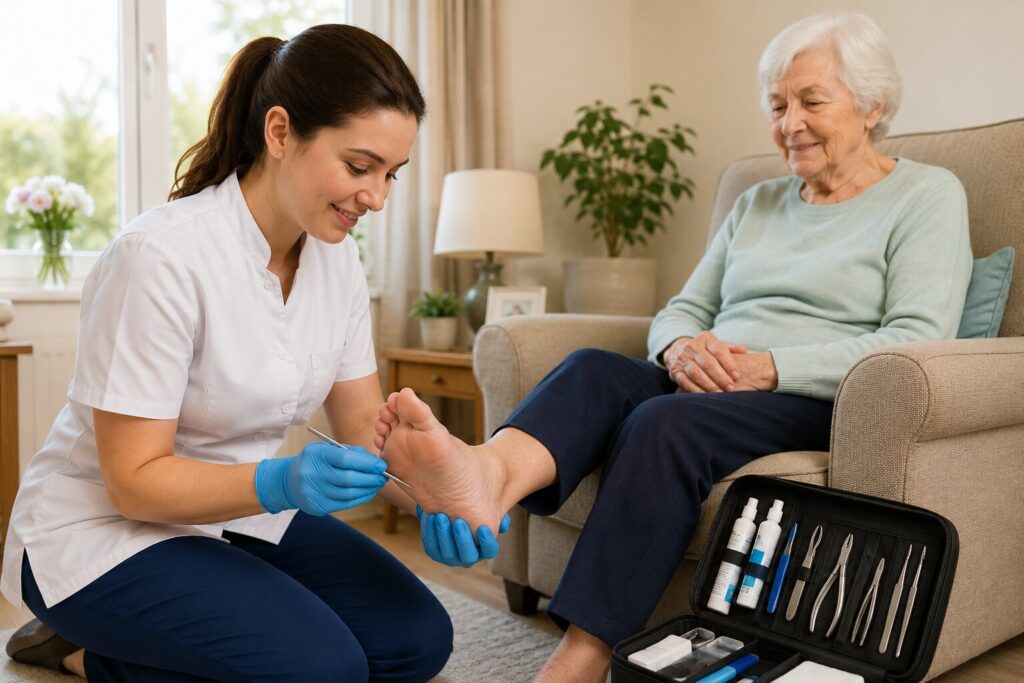
Short answer: A home visit from a podiatrist, chiropodist or foot health practitioner typically costs £45 to £75 in the UK for routine foot care — usually £10 to £25 more than the same treatment in a clinic. Some practitioners add a travel charge outside their normal area. NHS home visits are free but limited to housebound patients who meet local criteria.
For a lot of people, getting to a clinic is the hard part. If you can’t drive, can’t manage stairs, or are looking after someone who can’t easily leave the house, a practitioner coming to you isn’t a luxury — it’s the only realistic option. Here’s what it costs and how it works.
Typical UK prices
| Type of appointment | Typical cost |
|---|---|
| Routine home visit (nail care, corns, calluses) | £45 – £75 |
| Same treatment in a clinic | £30 – £50 |
| First appointment with fuller assessment | £50 – £85 |
| Diabetic foot assessment at home | £55 – £90 |
| Travel surcharge outside normal area | £10 – £20 |
| Two people at the same address | Often £10 – £20 off the second |
Prices sit higher in London and the South East and lower in much of the North, Wales and Scotland.
That last row is worth knowing about. If you and a partner, or two residents in the same building, both need treating, most practitioners will discount the second appointment because they’ve only travelled once. Care homes and sheltered housing schemes often arrange regular group visits on exactly this basis.
Why home visits cost more
The extra £10 to £25 isn’t a premium for convenience. It covers real costs:
- Travel time. A practitioner might spend 20 minutes driving each way for a 30-minute appointment. That’s an hour of their day for one patient, where a clinic could see two or three.
- Fuel and vehicle costs.
- Portable equipment. Home visit practitioners carry mobile drills, sterilised instrument packs and portable chairs.
- Sterilisation. Instruments still have to be professionally sterilised between patients, which means carrying multiple sets.
Given all that, the difference is fairly modest. Many people expect home visits to cost double and are surprised they don’t.
Who provides home visits
Both HCPC-registered podiatrists and chiropodists and qualified foot health practitioners offer home visits, and for routine foot care either can help you.
It’s worth understanding the difference so you can pick sensibly:
HCPC-registered podiatrists and chiropodists have completed a degree-level qualification and are on the Health and Care Professions Council register, which is a legal requirement to use those titles. They can carry out nail surgery, prescribe certain medicines, and handle complex or high-risk cases — particularly important if you have diabetes, poor circulation or a wound that isn’t healing.
Foot health practitioners have completed vocational training in routine foot care. They handle nail cutting and thickened nails, corns, calluses and general foot maintenance. A great many housebound patients are looked after extremely well by FHPs, and they often have better availability and lower prices.
Which should you choose? For straightforward nail and skin care, either is fine — pick on availability, price and how comfortable you feel with them. If you have diabetes, circulation problems, a wound, or anything that isn’t healing normally, see an HCPC-registered podiatrist.
You can check any podiatrist or chiropodist’s registration for free on the public HCPC register.
What a home visit usually includes
A routine appointment lasts 30 to 45 minutes and normally covers:
- Cutting and filing toenails, including thickened or difficult nails
- Reducing corns and calluses
- Checking the skin for problems
- Basic circulation and sensation checks, especially for older or diabetic patients
- Advice on footwear and daily foot care
- Filing and finishing
The practitioner brings everything needed. You’ll want a firm chair with good light and a bit of space around it — a kitchen chair usually works better than an armchair.
How often are visits needed?
Most people on routine foot care are seen every six to ten weeks. Nails that grow quickly or thickened nails may need more frequent attention; some people are fine at twelve weeks.
At £45 to £75 a visit, six-weekly works out at roughly £390 to £650 a year, and ten-weekly at around £230 to £390. Many practitioners will set up a standing appointment so you’re not chasing a booking each time.
Can you get home visits on the NHS?
Sometimes, and it’s free where you qualify.
NHS podiatry home visits are generally for patients who are genuinely housebound — unable to leave home without significant assistance — and who have a clinical need beyond routine nail cutting. Priority normally goes to people with diabetes, peripheral arterial disease, or foot ulceration.
Routine nail cutting for otherwise healthy people is not usually funded by the NHS anywhere in the UK. This surprises a lot of families, and it’s the main reason private home visits exist as a market at all.
To find out where you stand, ask your GP for a referral to the local NHS podiatry service, or contact the service directly — many accept self-referrals. Criteria vary considerably between areas, so it’s worth asking rather than assuming.
What to ask before booking
- What’s your home visit fee, and does it include travel to my postcode?
- Are you HCPC-registered, or a foot health practitioner? (Both are fine for routine care — you just want to know.)
- What’s your registration or qualification, and can I check it?
- Are you insured?
- How do you sterilise your instruments?
- How often would you recommend visiting?
- Can you treat two people at the same address, and is there a discount?
- How do I pay — cash, card, bank transfer?
Any competent practitioner will answer these happily. Hesitation about registration or insurance is a reason to keep looking.
Arranging visits for a parent or relative
A few practical things that make it go smoothly:
- Be there for the first appointment if you can, so you can hear the advice directly and ask questions.
- Mention any medical conditions upfront, particularly diabetes, blood thinners, or circulation problems. It changes how the practitioner works.
- Set up a standing appointment rather than booking each time. It’s easier for everyone and means foot care doesn’t get forgotten.
- Ask about care homes. If your relative is in a home or sheltered scheme, there may already be a visiting practitioner, and joining that round is usually cheaper.
Frequently asked questions
Is a home visit as good as going to a clinic?
For routine foot care, yes. The main difference is that a clinic has fixed equipment and better lighting. For complex problems, imaging or nail surgery, you’d need to attend a clinic.
Do I need a referral?
No. You can book a private home visit directly.
How far will practitioners travel?
Most cover a radius of 10 to 15 miles, with a surcharge beyond that. Rural areas can be harder — it’s worth asking early.
Can they treat someone with dementia?
Many practitioners are experienced with this and home visits are often far easier than a clinic trip. Mention it when booking so enough time is allowed.
What if my relative is in a care home?
Ask the home first — most already have a visiting practitioner. You can also arrange your own if you’d prefer.
For a broader picture of podiatry pricing, see our guide to how much a podiatrist costs in the UK.
Find a practitioner who offers home visits
FootcareUK lists foot health professionals across the UK — HCPC-registered podiatrists and chiropodists, and qualified foot health practitioners. You can search by town and filter specifically for practitioners who offer home visits.
Find a practitioner who visits your area →
This article is general information, not medical advice. If you have diabetes, circulation problems, or a wound that isn’t healing, speak to a healthcare professional promptly.

Author: FootcareUK
Written by
FootcareUK Editorial Team
These guides give general information about foot health for a UK audience. They are not a substitute for a personal assessment — a podiatrist, chiropodist or foot health practitioner can examine your feet and advise on your own situation. If you spot something that looks wrong, tell us and we will correct it.