
Short answer: Private ingrown toenail surgery in the UK typically costs £250 to £400 for one toe, usually including the local anaesthetic, the procedure itself and follow-up dressings. An initial assessment appointment, if it’s separate, adds roughly £40 to £70. On the NHS it’s free, but access depends on where you live and why you need it.
If your ingrown toenail keeps coming back no matter how carefully you cut it, surgery is often the point you get to. This guide explains what it actually costs, what you’re paying for, and how to tell whether a quote is reasonable.
What ingrown toenail surgery involves
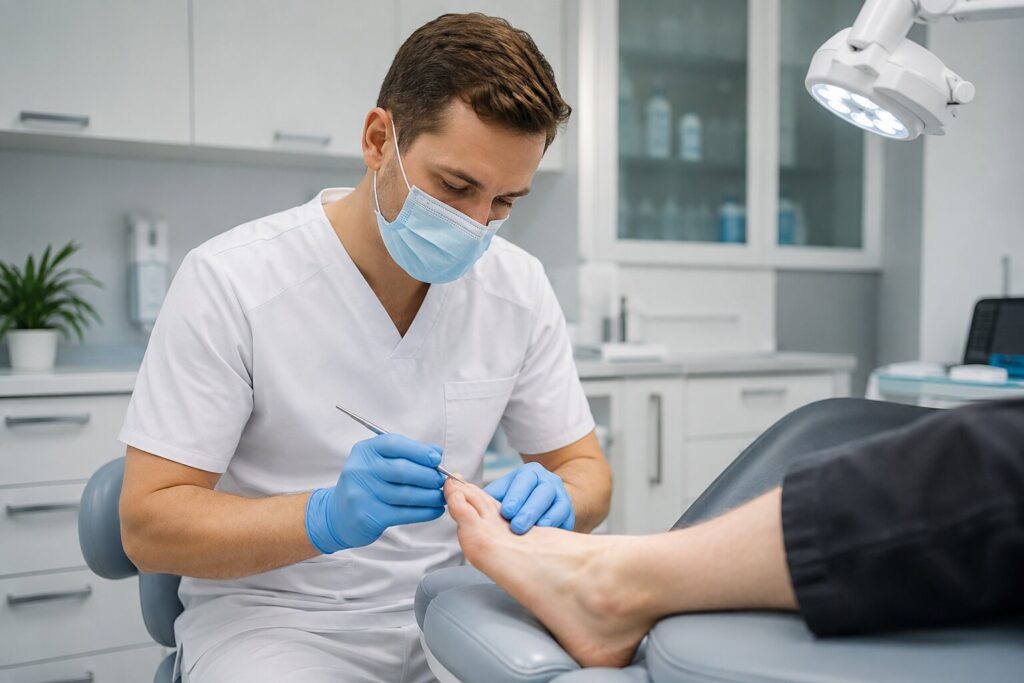
The procedure has a formal name — partial nail avulsion — and it’s more straightforward than “surgery” makes it sound.
The toe is numbed with a local anaesthetic injection at the base. The problem edge of the nail is removed, usually a narrow strip down one or both sides. In most cases a chemical called phenol is then applied to the exposed nail bed, which stops that strip growing back. That last step is what makes the fix permanent, and it’s why the procedure is often described as “with phenolisation”.
The whole thing usually takes 30 to 45 minutes. You walk out afterwards, though you’ll want sensible shoes and a lift home rather than a long walk.
Total nail avulsion — removing the whole nail rather than a strip — is less common and reserved for nails that are badly deformed or repeatedly infected across their whole width.
Typical UK private prices
| What you’re paying for | Typical cost |
|---|---|
| Initial assessment appointment | £40 – £70 |
| Partial nail avulsion, one toe, with phenol | £250 – £350 |
| Total nail avulsion, one toe | £280 – £400 |
| Second toe treated at the same appointment | £80 – £150 extra |
| Follow-up dressing appointments | £15 – £30 each, often included |
| Conservative treatment (removing the offending spike only) | £40 – £70 |
Prices vary quite a bit by region — London and the South East sit at the higher end, and clinics in smaller towns are often noticeably cheaper.
The most important thing to establish is whether the quoted price is all-in. Some clinics quote a single figure covering assessment, procedure, dressings and every follow-up. Others quote the procedure alone and charge separately for each redressing appointment, of which you might need two or three. Those two quotes can look £100 apart and end up costing the same.
Who is allowed to perform it
This matters more than most people realise.
Ingrown toenail surgery involves injecting a local anaesthetic and applying a chemical to the nail bed. In the UK this is carried out by an HCPC-registered podiatrist or chiropodist. HCPC registration is a legal requirement to use those titles, and you can check any practitioner’s registration for free on the public HCPC register.
Foot health practitioners cannot perform nail surgery. FHPs do excellent, valuable work — routine nail care, callus and corn removal, general foot maintenance, and they’re often the people keeping older or less mobile patients comfortable and walking. But administering local anaesthetic and performing nail avulsion falls outside their scope of practice.
So if you need surgery specifically, you’re looking for an HCPC-registered podiatrist. If someone offers to perform nail surgery and isn’t on the HCPC register, walk away.
Can you get it done on the NHS?
Yes, and it costs nothing — but access is the catch.
You’d normally start with your GP, who can refer you to NHS podiatry. Whether you’re accepted depends on local criteria, and many areas prioritise patients at higher risk of complications, which generally means people with diabetes, poor circulation, or a compromised immune system.
If you’re otherwise healthy with a painful but uncomplicated ingrown toenail, some areas will treat you and others will tell you it’s not a funded service locally. Waiting times, where treatment is available, run from a few weeks to several months.
This is why a lot of people end up going private for something the NHS technically provides. If you’re in pain now and the toe is infected, a few hundred pounds to have it dealt with next week is a different proposition to waiting four months.
What affects the price
How many toes. Two toes in one appointment always costs less than two separate appointments, because you’re only paying once for the practitioner’s time and the setup.
Partial or total. Removing the whole nail takes longer and needs more aftercare.
Whether phenol is used. Removing the nail edge without phenolisation is cheaper, but the nail grows back and the problem often returns within a year or two. Most practitioners recommend the permanent version for recurring ingrown nails, and it’s usually better value over time.
Region. Expect to pay more in London and the South East.
Whether there’s an active infection. An infected toe sometimes needs treating before surgery can go ahead, which may mean an extra appointment and a course of antibiotics from your GP.
What to ask before you book
- Is the quoted price all-inclusive, or are follow-up dressings charged separately?
- How many follow-up appointments should I expect?
- Will phenol be used, so the nail edge doesn’t grow back?
- What’s your recurrence rate?
- Are you HCPC-registered, and what’s your registration number?
- What happens if it gets infected afterwards — is aftercare included?
A good practitioner will answer all of these without hesitation.
Is surgery always necessary?
Not always. If it’s the first time, or the nail is only mildly irritated, a podiatrist can often just remove the offending spike of nail and relieve the pain in a single appointment for £40 to £70. Plenty of ingrown toenails never come back after that.
Surgery becomes the sensible option when the problem is recurring — you’ve had the same toe treated two or three times, or it flares up every few months. At that point you’re spending as much on repeat appointments as you would on a permanent fix.
It’s worth seeing a podiatrist rather than deciding for yourself. They’ll tell you honestly which category you’re in.
Recovery
Most people are back to normal daily activity the next day, with some soreness once the anaesthetic wears off. Expect to wear open or roomy shoes for a week or so, keep the toe dry for the first 48 hours, and avoid swimming and sport for two to three weeks.
Full healing of the nail bed takes six to twelve weeks, though it stops being sore long before that.
Frequently asked questions
Does it hurt?
The anaesthetic injection stings for a few seconds. The procedure itself is painless. Afterwards it’s usually described as an ache rather than sharp pain, and paracetamol is normally enough.
Will the nail look normal afterwards?
After a partial avulsion the nail will be permanently narrower on the treated side. Most people don’t find it noticeable. After a total avulsion, if the nail bed has been phenolised, the nail won’t regrow.
How long until I can drive?
Most people are fine to drive the next day, but not immediately afterwards while the toe is still numb.
Can it come back?
If phenol was used, recurrence is uncommon — generally under 5%. Without phenolisation, regrowth is much more likely.
Do I need a GP referral to go private?
No. You can book directly with a podiatrist.
For a broader picture of podiatry pricing, see our guide to how much a podiatrist costs in the UK.
Find a podiatrist near you
FootcareUK lists foot health professionals across the UK — HCPC-registered podiatrists and chiropodists, and qualified foot health practitioners. You can search by town and filter by the type of care you need.
For nail surgery, look for an HCPC-registered podiatrist and check their registration number on the public HCPC register before you book.
This article is general information, not medical advice. If your toe is hot, swollen, badly infected or you have diabetes or circulation problems, see a healthcare professional promptly rather than waiting.

Author: FootcareUK
Written by
FootcareUK Editorial Team
These guides give general information about foot health for a UK audience. They are not a substitute for a personal assessment — a podiatrist, chiropodist or foot health practitioner can examine your feet and advise on your own situation. If you spot something that looks wrong, tell us and we will correct it.